Pages

Monday, March 14, 2011

Fiestas in Review

From last Thursday to Tuesday of this week, the majority of Ambato took a five-day weekend to celebrate the city's signature celebration: The Festival of Fruit and Flowers. My mini-vacation started on Thursday when I went to a carnival with my students after class.

Playland Park

Amusement parks have been set up in a couple of locations in Ambato for a few weeks now, but this past Thursday was the first time I have actually entered one. Since English class Thursday night was the only thing standing between my Advanced students and the Fiestas, they were getting unruly after the first half hour and pretty much refused to do anything I told them to. A student suggested that we go to one of the amusement parks called Playland Park, and she promised that if we went every student would get on the scariest ride. Always the cool teacher, I said yes.

After doing the Tarzan Swing in Mindo, I didn't think I would be scared by any of the rides the dinky amusement parks in Ambato would have. I was right that they were dinky, but wrong that they wouldn't be scary. Take for example this carelessly thought out ride:

Safety harnesses are for pussies anyway
When I did a lap around the park to see which rides I would want to go on, I spotted this one before it started going. It appeared to be a tame ride that just tilted back and forth. I was right that it just rocked back and forth and bounced around a bit, but the kicker was that there was nothing that held the riders in their seats. People were forced to hold on to the metal bar along the outside of the circle while their bodies were flung into the air and slammed onto the hard plastic chairs on the way down. My tailbone was hurting from just watching it in action.

After checking out all the rides Playland Park had to offer, we agreed that the scariest ride in the park was a huge spinning/rotating attraction called Evolution.

Unlike the first ride I described, to get on Evolution you actually had to be strapped in. The ride didn't seem like it would be scary because it was moving very slowly. Terror only struck me when the ride inverted us and brought us far into the sky and all my weight was being supported by the harness I assumed that I was locked into.

It was at the peak of Evolution's motion I realized that my life was resting on the functionality of the safety harness, which was put together by carnies working at a traveling amusement park in a third-world country. I was preoccupied the entire time by thoughts of falling to my death before I even got to go to the Amazon Forest, but I survived and it turned out to be a cool ride to be on because we got a great view of the city (even though it was upside-down) when we were at the top.

Only one student didn't go on Evolution because he claimed he had a "heart condition." Lame.


I Want My Ambato Back

During the Fiestas there were fun events going every day like parades, concerts in the streets, and live music at most venues. The only problem was that there were so many people in the city that Ambato really lost its best feature, which is the fact that it is a calm, small city that is cheap to have fun in. During the fiestas, bars that are usually free to enter were charging upwards of ten dollars to enter and I paid three times as much to get a taxi from my house to the neighborhood where my friend lives.

Matters weren't helped by the fact that the only public transportation we have here in Ambato is the buses, and they stop running after 7:30 pm. This means that the traffic is atrocious from all the people trying to drive to where they are going (further complicated by the main streets being blocked off due to parades), it takes forever to get anywhere, and taxis charge whatever they want because they know you don't have any other options.

That is not to say that the Fiestas were all traffic jams and ten dollar covers, however. The most fun night I had during the Fiestas was when I just walked around the main street in Ambato with my friends enjoying a free outdoor concert and dancing outside.

Ambato is noted for being one of the few cities in Ecuador where people do not throw things at each other in the streets during Carnaval. In other cities like nearby Guaranda, the masses toss around water, eggs, and flour. While there was no aerial exchange of food-stuffs in Ambato, lots of people did spray colored foam at each other. While it was sometimes annoying to get foam in my eyes or have my shirt dyed green and orange for the night, it was all in good fun and I was surprised at how every single person I saw get sprayed was a good sport about it (except my friend Will who had his phone stolen while being sprayed; he was kind of a baby about it).

Carnaval foam-warriors
Fruits and Flowers

I had joked earlier on during the Fiestas that there were not many fruits or flowers to be seen in Ambato, but my criticism was finally addressed when they put up a huge mural on the cathedral in the center of the city made up entirely of fruits, flowers, and bread.

Things to find in this picture: Jesus, dove, sunglasses, Winnie the Pooh
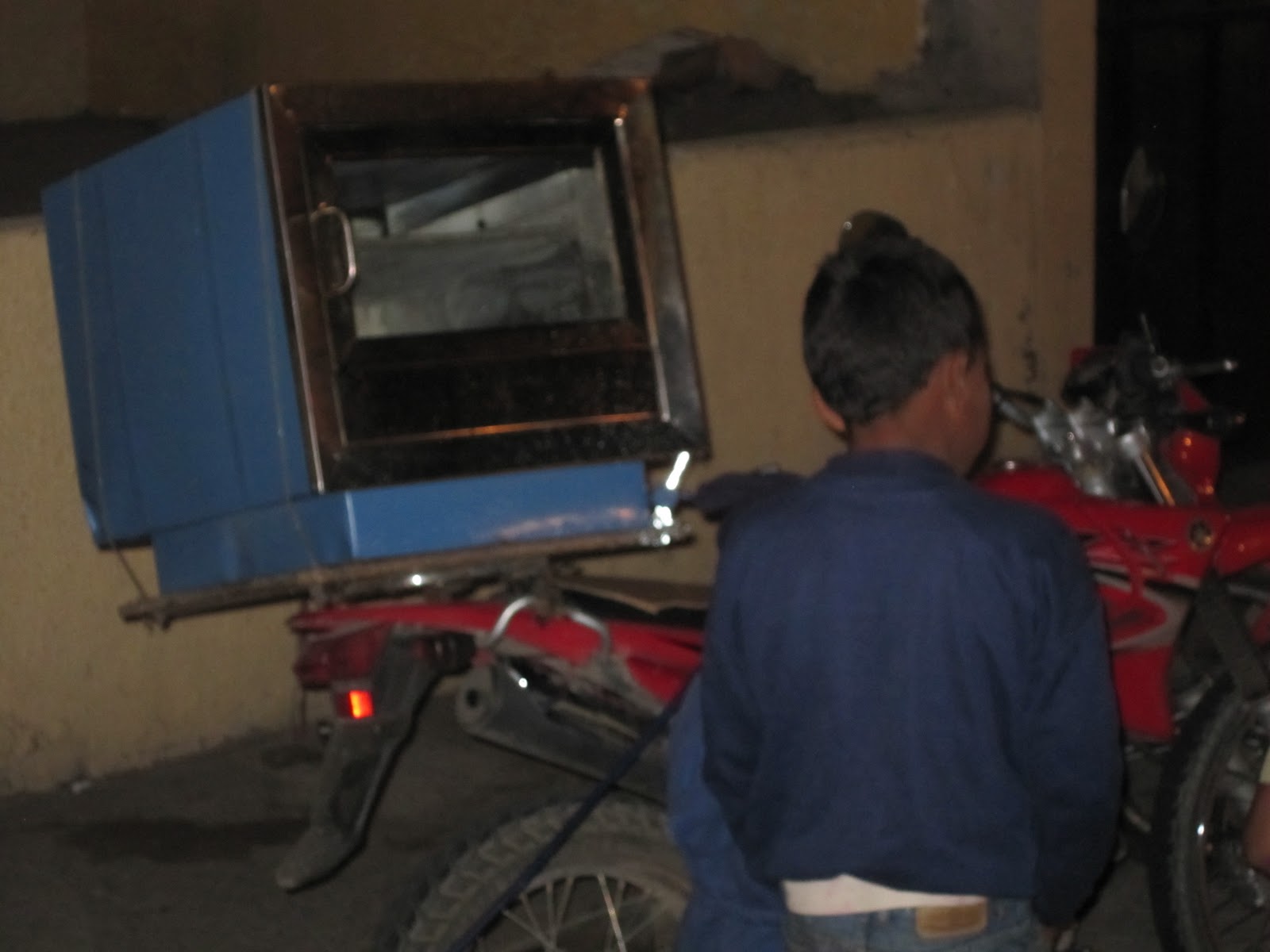
For the entire five days the streets were packed with vendors selling all kinds food. The first day at Playland Park I even saw some guy who was selling pizza that he was cooking in an oven on the back of his motorcycle. I have no idea what was powering the oven because after I took a picture of his bike he got mad and started yelling at me before I could get a closer look.


From the start of the Fiestas I had been eating questionable street food multiple times a day and I felt fine, but it finally caught up with me on the second to last night of the long weekend. I had one too many fig and cheese sandwiches from a lady in the park and I had to sit the final night out, which was just as well because by that time I was done with the congestion in Ambato, and I am relieved that we are back to being a city that no one cares to visit.

Ambato Classic

There are two soccer teams in Ambato that share the same home field, Bellavista Stadium. Today was the Ambato Classic when the two teams, Técnico Universitario and Macará, play each other for Ambateño glory. Both teams are in the "B" division of Ecuadorian soccer so the games at Bellavista Stadium normally do not draw many spectators. Today was certainly an exception, and when I arrived at the stadium an hour before the start of the game there was already a line extending across the street to enter.

I went with my friend Caitlin, and when we got to the stadium we had to make the important decision of which team to root for since they were both from Ambato. The decision was crucial because the stadium was essentially split in half, and each side was filled with fans of only one of the teams (side note: the stands looked awesome because one half of the stadium was all red from Técnico fans and the other half was all blue from Macará fans). We decided that since the line to get into the Técnico side was longer, we would be Macará fans for the day, so we bough a couple of knock-off jerseys outside the stadium and headed to the Macará section.


Casual Macará fanfare

The game was fun, but not nearly as crazy as I have heard the "A" division games are in the bigger cities. If anyone was looking forward to a story about me getting into a brawl with an opposing fan or getting tear-gassed by riot police, I suppose it will have to wait until I make it to a Liga game in Quito.


Speaking to Writing

One of the unlikely advantages of having learned Spanish from mostly non-native speakers in the States came of the tendency of many English speakers to overlook the fact that in Spanish, the letters "v" and "b"—as well as "s" and "z"—sound the same. Because of this oversight, I have always been able to spell words with these letters correctly because I say them differently in my mind. For instance, when I was learning Spanish I always read the word hizo with a voiced consonant sound, and that word would sound different than hiso in which the "s" is not voiced.

Since I have been paying more attention to my pronunciation and trying to eliminate my foreign accent the best I can, I have noticed that my spelling is getting worse. Now that I pronounce letters the way they are supposed to be pronounced (identically), I am making orthographical errors that I never used to make before. Just today I wanted to type vaya, but as I said it out loud my fingers instinctively typed baya to correspond with how I was pronouncing it.

Similar to my spelling regression, my attempts to sound like a native speaker are creating unforeseen problems for my spoken Spanish as well. In English, the "b" sound is bilabial, which is to say that it is articulated using both lips. In contrast, the "v" sound is labiodental, which means that it is articulated with the lower lip and the upper teeth. In Spanish, both of these letters are bilabial and they both sound like our English letter "b."

As I am eliminating my use of the labiodental "v" sound, I am also accidentally eliminating other labiodental sounds that Spanish does have. For instance, I have told cab drivers multiple times in the past few weeks that I want to go to Picoa (bilabial "p" sound) when what I really wanted to say was Ficoa (labiodental "f").

Wedding Crasher

I guess I'm not really a wedding crasher since I got an invitation, but this weekend my host brother Ricky is getting married. Thankfully I brought my interview suit back with me from my last trip to the States so I have something to wear. While I have never been to a wedding in my adult life, I have a hunch that I am awesome at making wedding speeches, so I hope I can make it to a microphone before anyone realizes I am not part of the family and don't really speak Spanish that elegantly and tries to stop me.


Tsunami

Due to the massive earthquake near Japan, there was a tsunami warning all along the Pacific coast including Ecuador. Luckily I live way up in the mountains in the center of the country, so everything was fine in Ambato. Even on the coast of Ecuador, a state of emergency was declared and people in danger had time to evacuate, so as far as I know Ecuador escaped unharmed from the potential threat. My thoughts go out to everyone affected by the tsunami.

Sunday, February 27, 2011

Ambato Shore

This week appears to have been the start of the annual festival in Ambato called The Festival of Fruits and Flowers (I am somewhat uncertain about whether it has actually begun because depending on who you ask, the festival either started in the beginning of February or will begin to coincide with Carnaval in March). The festival in Ambato is so named because of the prodigious amounts of fruits and flowers that are supposedly produced in Ambato during this season, although I admit that I am not impressed with the displays of either so far.

One of the events I went to this week was a concert in one of Ambato's parks, and I was excited to try Ambato's signature fruit that I have still not eaten yet called guaytambo. To my dismay, there wasn't fruit of any kind being offered on the streets (not to mention that I didn't see any flowers either). Based on what I saw a lot of that night, I propose that this celebration be renamed the Festival of Street Hotdog Vendors and Boxed Wine.


We Have a Situation

During the concert I alluded to earlier, there was one guy in the crowd who caught my attention almost from the start. He was quite a distance from me, but I noticed him because he was standing on an elevated surface and wearing sunglasses and a tight v-neck shirt. His outfit was complimented by the fact that he kind of looked like The Situation from Jersey Shore. The resemblance became even more striking when he started pulling up his shirt and rubbing his abs at people walking by.

After seeing him flaunt his body at a few innocent passersby I decided that I urgently needed a picture with him, so I pushed my way through the crowd and asked him if he would pose for a photo with me. In what had to have been the best possible response to that request, he asked me "Shirt on or off?"

La Situación
After the picture he gave me two high fives and started waving his shirt over his head.

I'm a Cool Teacher, but my Students Aren't Bad Either

Pretty much the only positive part about teaching at SECAP is that almost all of my students are adults so they like to plan activities together and we sometimes hang out after class. On Friday, my class planned a trip to a recreation center in a nearby city called Salcedo. The place was surprisingly nice, and for four dollars each we got to use swimming pools with water slides, a hot tub, saunas, volleyball courts, and a soccer field for the whole day. Afterward we ate lunch, and my students didn't let me pay for anything the entire trip.

With some students at lunch.


One of my students from last semester who couldn't continue English classes because she just started medical school even showed up, and it was nice to hang out with her since we hadn't seen each other in a while.

"Damn right I like the life I live." -Adriana's baby
Adriana, a student of mine, brought her baby on the trip. I forget the baby's name, but she was kind of a boss at one point when she fell asleep drinking out of her bottle so I took a picture.


Talking with Personality

A frustrating part of learning a language is how proficient you need to be before you can actually show your personality around other people in a non-native tongue. For instance, my personality is expressed mostly through bad puns and one-liners. Unfortunately for me, humor requires a high degree of facility with a language because you need to be able to respond quickly to other people to make a joke and you need to know what kinds of things a certain culture finds funny. So unless you have no personality to begin with, being yourself while speaking a foreign language takes a lot of time and practice.

This weekend when I was driving around with my students, one of the people in the car was a friend of the driver who didn't know me. She asked how much Spanish I spoke, to which one of my students replied "Teacher knows how to make jokes in Spanish!" That was an interesting comment to me for two reasons:

First, it supports the claim that conveying personality (especially humor) denotes a high level of language proficiency because my student was using the fact that I know how to make jokes as a measuring stick for how much Spanish I speak. Second, that was the best compliment I have ever received about my Spanish because he didn't say anything about how well I am able to articulate ideas; he said something about how I am able to convey my personality in Spanish, which is reassurance that my Spanish has been improving in an important respect since I have been living here. After all, who cares if you can speak a foreign language fluently if you sound as interesting as a spelling bee champ when you talk.

Another unrelated but funny part of that car ride was when the person who wasn't my student kept calling me "teacher" because that was what everyone else was calling me and she didn't know my real name.

Sunday, February 20, 2011

Things Ecuadorians Like: Being Old and Doing Things

You don't need to spend a lot of time in Ecuador to realize that the old people here are a lot different than the old people in the United States, and I'm not just talking about felt hats and ponchos. The truth is that in their old age, something happens to Ecuadorians that turn them into some of the most resilient people I have ever witnessed.

This contrast was brought to my attention recently when I read an article about a program in some American city that links joggers up with elderly people so that active young men and women can go shopping and deliver food to less able-bodied old people while they are running on their routes. If you tried to help an old Ecuadorian walking down the street carry something, she would probably call you a penis-face and slap you away.

"Take your stinking paws off me you damn, dirty American."
Go to the center any day of the week and you will see men and women older than electricity carrying huge crates and bags filled with produce on their backs. I will occasionally see someone with a full load booking it down the street at maximum senior citizen velocity that makes me wonder if I would be able to do what they are doing now, let alone in my seventh decade.

So what is it that makes old Ecuadorians so much more capable of doing things than their first-world counterparts? I think it is due in large part to the fact that in Ecuador, old people don't get any special treatment. Nowhere is this more evident than on the public buses.

I have already talked about the chaos that is the public transportation system in Ecuador at length, and nothing about that experience is different for old people. If an elderly person is getting on the bus, the driver will start to pull away as soon as both feet are in the vehicle. This sends old people bouncing back and forth in the aisle, fumbling with whatever bags or buckets they are holding until they finally rebound into a spot where they can sit down or lean against a wall.

Old people are impressive to watch getting on the bus, but they are even more tenacious when it is time to get off. Forget appealing to their fellow passengers to clear out a path for them to exit on account of their advanced age; old Ecuadorians just elbow and claw their way through the mass of passengers and scream at the bus driver to stop the bus so they can get off (which is occasionally followed by a chain of mumbled expletives as they are walking down the stairs). This would be a good time to additionally note the unusual physical strength of old Ecuadorians. I speak from experience, as my ass has been the target of many a wrinkled elbow strike launched by an exiting grandma.

On the plane back to Ecuador from my last trip to the U.S., I started talking to the old Latina woman sitting next to me because the stewardess wanted to tell her something but didn't speak Spanish. It turned out that she was from Quito and we had a long talk that involved a lot of me not understanding what she was saying and smiling and nodding in response. I saw that she had an American passport and wondered whether she was really from Ecuador or if she was only going to visit her family (after all, it is incredibly difficult for an Ecuadorian to get American papers). She proved to me that she was a true Ecuadorian when she had to use the bathroom, and instead of asking me to get up so she could get into the aisle, she just climbed over me without saying a word.

My host father is the model of an old person who does things. He is a retired civil engineer, but after he retired he bought a farm and now he goes there every day to take care of his plants and animals with the goal of expanding his land and increasing his production every year. One time a family member was over and my host father gave him a great speech which went something like this: "When most people retire, they sit in front of the T.V. and stay there for another five years until they die. One has to keep active and continue to challenge himself to have something to live for and keep going."

When I grow up I want to be a doctor, but when I get old I want to be an Ecuadorian.

Thursday, February 17, 2011

Back for Good

This past weekend I returned to Ambato from my trip to the United States for what will hopefully be an uninterrupted stay in South America for my remaining five months as a WorldTeach volunteer. Similar to the first time I went back to the States in October, my trip was mostly business and I am relieved to be back on a schedule and working again. Big thanks to Nathan, Jill, and Olivia for letting me crash at their places at various times throughout my trip so I didn't ever have to stay in a hotel.

Learn English through Astrology

A few days before I left for the States, my host family's housekeeper asked me if I could help her daughter, who happened to be in the house at the moment, with her English homework. I am always happy to help little kids with their homework because they are very easily impressed with things that adults find effortless, like counting by two's and spelling "elephant."

I was expecting a standard, basic-level homework assignment similar to the kind of Spanish homework I got as a kid, maybe colors or numbers. What I forgot is that the Ecuadorian education system leaves a lot to be desired, and the book the girl had was no exception. The exercise the girl was assigned provided several pictures of people with different haircuts. Underneath the pictures of different hairstyles was a list of adjectives and corresponding astrological signs. The directions asked the student "In your opinion, what sign of the Zodiac matches each hairstyle?"

They forgot to put "Douche-bag Taurus" for letter e.
I have lived in Ecuador for several months now and I have seen my fair share of terrible educational materials, but this book takes the cake. It's bad enough that someone writing an English book thought that matching hairstyles to signs of the Zodiac would be a good idea for an exercise in a basic-level book, but then some teacher saw it and thought to himself "Wow, what a great activity! I agree that this is pertinent information for someone trying to learn English to improve his chances of someday getting a job in an Anglophone country."

Keep in mind that this exercise was assigned to a student who didn't even know the letters of the alphabet in English when I asked her to spell something or the word "green" when I asked her what color her pen was. I can imagine what an interview would have to sound like for any student using this book to be successful in the future:

- Mr. Nuñez, so far I've asked you how you are doing, where you are from, and how old you are, all of which you replied to by staring at me blankly.
- (*continues staring blankly at interviewer*)
- To be completely honest, those questions were all just small talk to get you warmed up. Next comes the most important question we will discuss today, and the answer will ultimately decide for me whether you are right for the job or not. The question is: Using only an adjective and an astrological sign, how would you describe my hairstyle?

Say What?

I learned to speak Spanish while studying abroad in Mexico, so before I started working with WorldTeach I was only accustomed to Mexican Spanish. One of the most salient differences between Mexican Spanish and Ecuadorian Sierra Spanish is how they pronounce words containing "ll". Most of the time, pronunciation differences between different dialects has little effect on practical usage and it only serves as an indicator of where someone is from. In the case of the "ll", however, there are some interesting consequences that arise from how speakers from different countries pronounce it.

In Mexico, the "ll" makes the same sound as "y" (pronounced like the "y" in the word yes). This may lead to ambiguity in cases where two words are spelled exactly the same except that one has a "ll" and another has a "y". For instance, se cayó (he fell) and se calló (he shut up) would be pronounced the same in Mexican Spanish. Most of the time ambiguities like this are easily resolved by the context of the conversation, but it can have disastrous consequences for spelling. If someone hears a word before he ever sees it spelled out, he will have no idea whether it should be spelled with a "y" or a "ll", which occasionally leads to some sloppy spelling.

The Spanish that Ecuadorians from the Sierra speak, however, makes a distinction between these two sounds. The letter "y" retains the same pronunciation, while the letter "ll" sounds something like the "zsa" in "Zsa Zsa Gabor" or the "j" in "Jack". With Ecuadorians from the Sierra, it is impossible to make the kinds of spelling mistakes that would occur in Mexico (or even on the coast of Ecuador, where they also don't distinguish between the sounds of those letters). It is pretty interesting to me to think that Serranos probably spell a bit better than people from the coast because of their accent and the ambiguities it dispels.

Another classic example of how pronunciation affects spelling (and to a much lesser extent, comprehension in spoken language) is the pronunciation of the letters "s" and "z". In some parts of the Spanish speaking world, the letter "z" is pronounced like the "th" in "the". In Latin America, however, "s" and "z" are pronounced the same and spelling errors can lead to comical changes in meaning. This ad in today's newspaper pokes fun at this type of spelling mistake and how it would not be surprising for someone to accidentally write cazar (hunt) instead of casar (marry).

"When you're married you're as good as dead anyway, so what's the difference—am I right?"


Luxuries of the 21st Century

There are a lot of technological "advances" that have done little to really improve life, like 3D television and iPads. However, I feel that people who are overly cynical about new technology often unfairly judge innovations that truly improve quality of life. I would like to take some time now to highlight two such inventions: the electric toothbrush and Franklin's electronic Spanish-English dictionary.

I bring up the electric toothbrush because a friend of mine recently mocked me for bringing it with me when I travel. "Is this your toothbrush in the bathroom?" she asked, "You think you're better than us because you don't use a normal toothbrush?" Yes Jill, as a matter of fact I do think that I'm better than you for using an electric toothbrush. I haven't read any research that proves that using an electric toothbrush is more effective than a normal brush, but use an electric toothbrush just once and try going back to your bristle-stick after feeling the ecstasy of 31,000 strokes per minute stimulating and refreshing your gums while blasting away disease-causing plaque.

The second technology I am supporting is only relevant for people who are learning Spanish. All throughout college I used either a paper dictionary or an internet dictionary. The internet dictionary I use (wordreference.com) is probably the best dictionary available anywhere, but it is obviously not very mobile because I need to have a computer and internet connection available to access it. Using a paper dictionary is also not very practical because the number of entries is limited unless you have a gigantic tabletop edition and it is time consuming to flip through pages to find a word.

It is beyond me how knowledge of the existence of an excellent portable electronic dictionary evaded me for four years as a Spanish Literature major, but now I have seen the light and there is no turning back. I highly recommend the Merriam-Webster electronic dictionary made by Franklin. It is small enough to fit in my pocket so I carry it with me all the time and use it incessantly (it has a regular English dictionary as well, and I just used it to make sure "incessantly" meant what I thought it did).


Search Keyword Abuse

I would like to give kudos to whoever searched the term "krishna surasi is stupid" into a search engine and used the results to connect to my site multiple times. Whoever it was searched that term enough times that "krishna surasi is stupid" is now the number one result on the list of search terms that people use to find my site (a list that I can view on the statistics tracker on Blogger). Well played mysterious Blogger stat-tracker manipulator, well played.

Sunday, February 6, 2011

I'm Off!

The past several days have been quite busy for me as I worked through my second week of classes this semester and prepared for the two medical school interviews I have coming up this week. I leave tomorrow morning when my first stop will be Canada to visit the University of Buffalo, followed by a trip to East Flatbush, Brooklyn—the home of Roosevelt Chapman (along with some other notable residents)—to try my luck at Downstate.

Things I've Heard this Week

I didn't do anything very exciting this week, but I did hear some things that made me laugh that I would like to share.

First, a conversation with my friend Matt who lives in Chicago:

Me: I booked my flight to Buffalo a day earlier than the interview because I heard there is bad weather in the States right now.
Matt: It's true; yesterday we had a thunder blizzard.
Me: A thunder blizzard!?
Matt: Yeah, it was crazy.


Next, a friend of mine, Georgia, broke her sandal while walking in the park and another friend, Peter, shared an interesting observation from his personal experience:

Me: You broke your sandal? I'll give you a piggy-back ride.
Georgia: No thanks.
Peter: (In a slightly frustrated and disappointed tone) Nobody wants piggy-back rides anymore.
Me: Peter, you say that like you see people turn down piggy back rides with some degree of regularity.
Peter: Yeah, I ask my girlfriend like everyday and she always says no.


Not really that funny, but one of my students gave me a great response during a game where you have to create a question for the given answer:

Me: The answer is: Michael Jackson.
Student: Who is the King of Pop?


Sometimes I'm the one who says funny things, like when I was talking with my host family the other day trying to find a place to get my suit dry-cleaned and I accidentally said tierno instead of terno:

Me: Do you know a place where I can get my affection cleaned?
Host Family: *uproarious laughter and finger pointing at me*


And lastly, this gem from the new receptionist at the school I teach at:

Receptionist: Why does everyone call you Krishna?
Me: Because it's my name.
Receptionist: Oh, I thought it was just because you are Indian.


Well, I hope they sell winter coats at the Buffalo airport because I don't have anything heavier than a hoodie with me here in Ecuador. At least this trip will give me a chance to wear the scarf my mother sent me for my birthday that I have not had the opportunity to use on the Equator.

Sunday, January 30, 2011

Round Two: Teach!

Betty Azar Changed my Life

This week I made copies of my custom books, put on my wristwatch, and combed my hair to the side for the real start of my second semester teaching English. After abysmal turn-outs the day we were supposed to start teaching at SECAP, we delayed the start of the semester two weeks and now I actually have a respectable number of students. I have eleven in both of my classes, which is about half of what I had last semester but a great number for a language class where face-time with the teacher is much more important than in other subjects.

In an attempt to remedy the worst part of teaching at SECAP (not having a book or curriculum), I prepared a workbook for my class by pulling from a number of different ESL books I had lying around so that I have something to guide me, the students have something to study from, and I am not spending an hour every day before class making 200+ copies of random worksheets I found on the internet. I have only taught with the book for one week, but I can already confess that Betty Azar has changed my life.

First step to teaching English like a boss: Azar-up
After an extended break, it feels good to be working again and to see my students who have been absent from my life for the past month and a half. It had been so long since I taught that I was actually pretty nervous the first day of classes like I was when I first started. It is a lot easier this time though, because my students already know me and what I expect of them.

Search Words

Blogger (the website I'm using to write this blog) has a really cool stat feature that records things like how many people visit my blog and what country they are viewing it from. For instance, this month I got views from the United States, Ecuador, Spain, Russia, Sweden, Bangladesh, Canada, Germany, the UK, and Hungary. Most of the time when it is a country other than the U.S. it is only one pageview, so it is not like I have fans who read my blog regularly around the world. Still, it is really cool to think how easy the internet makes it to connect with people around the globe for free.

Outside of the location of viewers, one of the most interesting stats Blogger records is what words people type into search engines to arrive at my blog. Most of the time it is something like "Krishna Surasi's blog" or "e is for ecuador", but other times they are pretty unusual and it makes me laugh to see how people are directed to my blog.

For instance, one of the recent searches that led to my blog was "zipline jargon." Some dude was looking to learn zipline lingo so he wouldn't sound like an amateur when he hit the canopy, but instead he was lead to a story about how I feared I would soil myself while doing a massive bungee-swing.

Another one was "ecuador birthday traditions." Someone was probably preparing to visit Ecuador for her birthday and wanted to see what kind of fun celebrations she would be in for. What she learned when she read my blog was that she will get a sinus infection from having her face shoved into a cake and she will probably be whipped with a belt for every year old she is.

One of the searches that actually was appropriate was "leísmo en ecuador." I'm glad to see that someone who was interested in learning about leísmo in Ecuador was directed to my site, and I hope that they learned something from my reflections on the Spanish in Ecuador since it is a pretty specific topic that I don't think many people write about.

Culture of Travel

An aspect of Ecuadorian culture that I have gleaned by talking to people here is how the culture affects people's perspective on travel. I noticed from the beginning when talking to people about where to go in Ecuador that most Ecuadorians haven't seen a lot of places in their homeland. This is surprising because the country is so small and to get from one end of the country to the other is about a twelve-dollar, twelve-hour bus ride. As an American, it is absurd to think that Ecuadorians—who always tell me that I haven't experienced Ecuador until I have visited so-and-so city—have never been there themselves.

Part of the reason why Ecuadorians don't tend to travel much, even within their own country, is because of the culture. Ecuadorians are much more family-centric than we are in the States, and that fact is most obviously demonstrated by the large number of Ecuadorians I know who continue to live at home well into adulthood. My host brother, for example, is over thirty years old, married with a child, and he still lives with his parents. If people depend so much on living with their family, I understand a little better why it would be unappealing to travel far away from home.


Ecuadorians are always shocked to hear that in the States some parents kick their kids out of the house when they turn eighteen or finish college and they need to find their own places. I told this to an Ecuadorian last night and she asked me how an eighteen year old is able to pay for an apartment alone. When I told her that my mother continued living at home but had to pay her father rent she could not believe it. My parents should probably be concerned that too much Ecuadorian doesn't rub off on me, otherwise they might have me living in their basements for another ten years.


DELE


I have decided that while I am in Ecuador, I will take the test of Spanish language proficiency called DELE. The test is fairly comprehensive and even includes a one-on-one conversation with a tester. To prepare, I have signed up for classes at a local language institute inexplicably named Mega World.


When I told one of my friends that I would be taking Spanish classes to prepare for the test, he made a good point by asking me why I didn't just talk to people. I'm in Ecuador and everyone here speaks Spanish, so why can't I just walk around talking to people to practice?


While I agree that there is a great deal to be learned just by shooting the breeze with Ecuas around town, I know that my Spanish is not improving as much as it could if I was taking classes. At this point in my Spanish education, I can pretty much always convey the meaning I want and the person listening will almost always understand what I am trying to say. Just because I am understood, however, does not mean that I am speaking at the level that a college educated Spanish speaker should be at.


When I talk to people in Spanish, they see that I have studied it for a while and can communicate well. They therefore frequently let my mistakes slide uncorrected because they don't want to insult me or break up the flow of the conversation. The same thing happens in English when someone, like a professor from another country, always makes the same mistake but never fixes it because he is still perfectly understandable and no one has the nerve to tell a PhD that he doesn't know how to use the third-person singular "s".


Another reason why just talking to my Ecuadorian friends hasn't always been helping me learn Spanish is because when I ask questions about the correctness of various grammatical constructions, they rarely agree on what the right answer is. The other day after class as my students were filing out, I wrote two sentences on the board and asked them which one was correct. The responses ranged from both perfectly correct, to one very correct and one less correct, to one correct and one completely incorrect. 

People are not very good at analyzing their own language, so I am happy that I found a good language school here in Ambato to take classes and get my Spanish in top-form for the test.


Pronunciashun


I used to tutor Spanish in college, and I remember one time there was a guy who brought in a paper with a very bizarre spelling mistake he kept making throughout the entire thing. In present perfect constructions, he was writing "a" instead of "ha" for the third-person singular conjugation of the verb haber. I was further puzzled by the fact that when I asked him to read his paper out loud, he spoke with an excellent accent as if Spanish was his first language.


As I continued talking to him I found out that Spanish was the language he spoke at home growing up, so he was essentially a native speaker. Since he went to school in the States, however, he never learned to read or write in Spanish and he was rarely exposed to materials that would teach him correct spelling. Since Spanish reads exactly as it is written, he went the opposite direction and wrote it exactly as it sounds, which is a problem because some different letters have the same sound (in Spanish, the "h" in words starting with "h" is silent, so "ha" is pronounced just like "a").


The mistake made perfect sense after I took into account his background with Spanish, but at the moment it was incredibly confusing. Language classes in the States are so focused on objective measurements, so reading and writing are stressed more that oral examinations and exercises. Anyone who studies past basic Spanish would be exposed to the conjugations of the verb haber, so I couldn't comprehend how this student could possibly speak the language very well but commit such a grave spelling error.

This one student isn't the only person who makes spelling mistakes because of Spanish's homophonous letters. The other day I saw this sign on the streets of Montañita:

Translation: "Don't vote garbage"
The error in this sign arises from the fact that in Ecuador (and probably other places too, I'm not sure) "v" and "b" are pronounced the same (the English "b" sound). When people are spelling something to another person, they often have to clarify by sayin "b de burro/b grande" or "v de vaca/v pequeña" so that the person listening knows which letter they are referring to.


So while this sign could be encouraging the citizens of Montañita to not vote "garbage" politicians into office, it is likely a misspelled attempt at getting people to not botar garbage into the streets.

Thursday, January 27, 2011

Things Ecuadorians Like: Ecuador

In spite of the fact that the entire country of Ecuador is only about the size of the state of Colorado, its divisive geography has led to the development of distinct cultures in its different geographical regions.

The most well-known region outside of Ecuador is the Galápagos Islands, which are isolated from the rest of the mainland by 972 kilometers of water. Residents of the Galápagos have a much different experience than mainlanders due to all the crazy dinosaur-animals that live on the Islands and the international tourists they attract.

On the mainland, the Andes mountains cut through the center of the country and divide it into three more distinct regions. The far west area of the country are the lowlands of the coast, where the weather is hot and humid and the Spanish is so fast that it is often difficult to understand for the uninitiated.

Drive a few hours east (and about nine thousand feet high) and you will find yourself in my stomping grounds, the so-called Sierra. Due to the high altitude, the climate in the mountains is surprisingly temperate considering that some areas lie directly on the Equator. If hot weather breeds fast talkers, the chilly Sierra air lends itself to a much slower Spanish that makes mountain cities a great place to learn the language.

People on the coast are known for being more laid back and friendly than their mountain-dwelling compatriots, who are stereotyped as being snooty and conservative. Regionalism is particularly strong in these two areas, and debates about which region of Ecuador is the best are always heated.

Lastly, farther out east past the Sierra lies the Orient, where cities have sprung up in the middle of the Amazon Forest and you are likely to find yourself in a town where more people speak an indigenous language than the Castellano of Ecuador's Spanish conquerors.

Regardless of the diverse regional cultures and attitudes that pervade Ecuador, every Ecuadorian seems to have at least one thing in common: they all love Ecuador.

I cannot help but notice the startling amount of pride that Ecuadorians exhibit for their homeland. One of the first questions I had when I came to Ecuador was why there is a fingerprint on the Ecuadorian national soccer jersey. The answer is that it is a reference to a campaign throughout Ecuador to promote Ecuadorian pride and the purchase of products made in-country.

Translation: It's much better it it's made in Ecuador
The posters for this campaign highlight another way that Ecuadorians are constantly showing off their pride in their country, and that is by using the colors of the Ecuadorian flag everywhere. I have seen the Ecuadorian flag invoked in countless ads by layering yellow, blue, and red into whatever is being depicted in the photo.

It is also not hard to find any kind of clothing sporting the Ecuadorian "tricolor" (especially if you are looking for a tracksuit). The only red, white, and blue clothing I have seen recently are a pair of  American flag Zubaz. While these pants clearly demonstrate that the wearer is proud to be an American, they would surely draw ridicule if worn in public in the States (something that would never happen to an Ecuadorian wearing his flag's colors from head to toe).

If you laugh, you don't love America.


The idea that things made in Ecuador are better isn't simply a slogan thrown around by the government either; Ecuadorians really do love things that are from Ecuador. Exhibit A: Pilsener.

Pilsener is a beer brewed in Ecuador, and anyone not from Ecuador will tell you that it is terrible. Ecuadorians, however, love it and would only drink something else if it was the other beer brewed in Ecuador, Club.

At first I thought that the Pilsener preference was simply a matter of convenience since imported beers are more expensive and Ecuadorians would rather drink the cheapest brew available. False. I talked to an Ecuadorian recently who traveled to Germany for work. He assured me that he tried everything they had to offer and that Pilsener is still the best beer he has ever tasted (but what do Germans know about beer anyway, right?).

The Ecuadorian pride extends beyond the realm of commercial goods, and in my experience, Ecuadorians are also quite concerned about how their culture is portrayed and what their reputation is like in other parts of the world.

I have an Ecuadorian family friend who always calls other Ecuadorians out for being rude. Once we were in a touristy place and there were some tourists going up the wrong staircase while the people who worked there just watched. My family friend went off on the people working there about how they should be ashamed of themselves for not helping the tourists and that they are insulting Ecuadorians at large by being rude.

Another time, I was on the bus with a bunch of other foreign friends and the guy collecting fares tried to charge us more than the regular amount. I asked the Ecuadorian sitting behind me how much the ride should be, and within seconds there were at least four Ecuadorians around me yelling at the guy collecting money about how he shouldn't be doing things like that to tourists because we would think that all Ecuadorians are thieves.

In places like bus terminals and public bathrooms there are frequently signs posted on the walls saying "show your culture" that are essentially asking people using the facilities to be respectful and clean to represent Ecuadorian culture well.

Lastly, whenever Ecuadorians meet me for the first time, they are always very eager to hear about what I have done in Ecuador and offer their own suggestions about what I need to see. I have been invited by people I barely know to go on trips to the jungle because they assured me that my experience would not be complete if I didn't make a trip there. Ecuadorians are very aware and appreciative of the fact that I left the U.S. to live in Ecuador, and they in turn feel as if it is their duty to show me the best of what Ecuador has to offer in return.

All in all I am impressed with the enthusiasm and pride that Ecuadorians have for their country, and I have already been thoroughly convinced that Ecuador is a special country that has much more to offer than its size suggests, both in the diverse beauty of its nature as well as the quality of its people.